
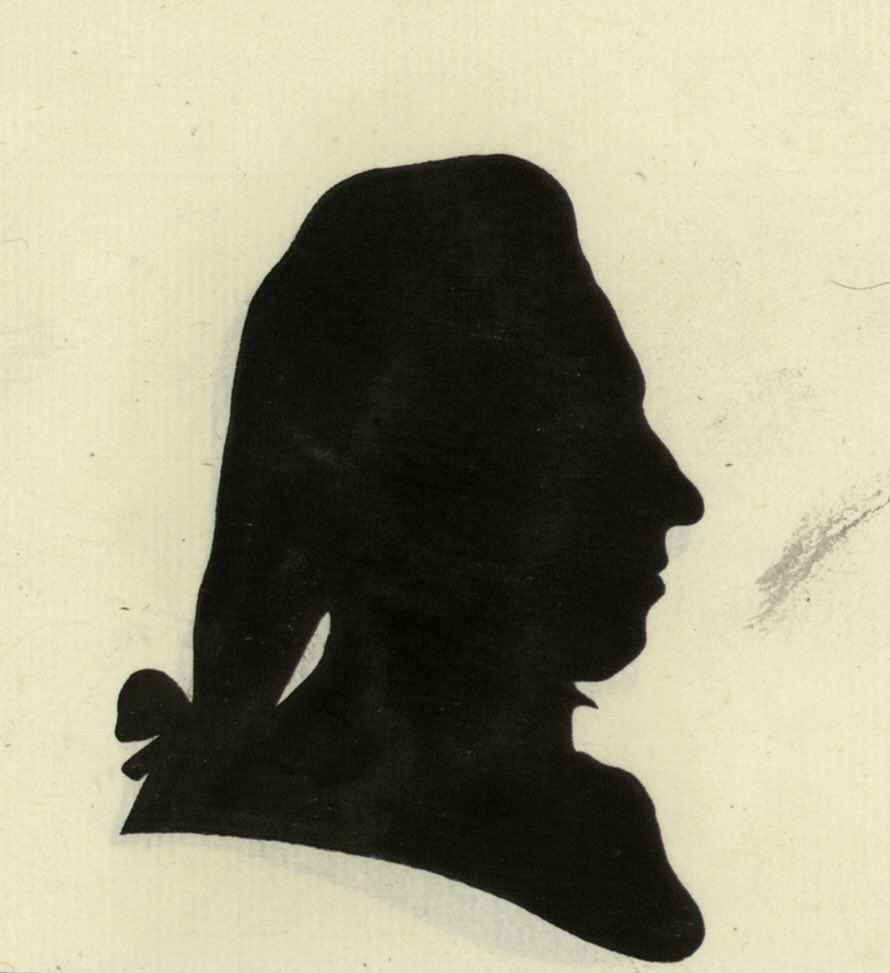
[Immagine tratta dalla Silhouetten-Sammlung Schubert, Niedersächsische Staats- und Universitätsbibliothek Göttingen, 8* Cod. Ms. hist. lit. 103 Cim., via Wikimedia Commons, pubblico dominio (https://commons.wikimedia.org/wiki/Category:Carl_Schubert_collection_of_silhouettes)]
This thematic section seeks to explore the intersections between biographical writing and historical writing, with particular attention to the images and representations of the eighteenth century that can be traced in the extensive and diverse body of biographical writing produced in subsequent decades.
The common thread running through the individual contributions is an interest in the ways in which those in positions of power have drawn upon the capacity of (auto)biographical writing to organise experience around the figure of the individual. This process entails an embodied and temporalised ordering of experience that combines descriptive and prescriptive functions, thereby contributing both to the interpretation of the past and to the transformation of the present.
Biography is considered, first and foremost, as a form of historical writing centred on events, that is, as a space in which narratives of historical events intersect with accounts of individual actions, particularly in the fields of political history and the history of science. Special attention is therefore devoted to the ways in which biographical trajectories shape the interpretation of collective phenomena, bringing certain aspects into focus while leaving others in the shadows. At the same time, biography is examined as a key instrument in the construction and legitimation of forms of knowledge, practices, and professions, especially when produced by institutions and disseminated through print. It is also explored as a means through which individuals respond to, negotiate with, or challenge institutions, particularly when biographical writing occupies the space between print culture and the manuscript archive.
As biographical trajectories unfold within specific contexts, biography also becomes a means of defining geographical spaces and collective identities, shaping narratives of the histories of cities, countries, and societies. Biographical production thus takes individual subjects as its point of departure while addressing collective audiences, contributing to the construction of shared identities and memories.
The chronological framework, extending from the late eighteenth century to the first half of the nineteenth, encompasses a crucial phase in the redefinition of the relationships between the individual, society, and history. In this respect, the thematic section not only brings together original research but also fosters renewed historiographical reflection on the legacy of the Enlightenment in the nineteenth century.
* * *
Issue 12/2027 of “Diciottesimo Secolo” contains three additional sections:
- Miscellaneous articles (subject to double-blind peer review)
- Notes and discussions
- Book reviews
The deadline for submissions is December 31, 2026.
Submissions should also include an abstract (max. 1,500 characters, including spaces) and five keywords.
The length of the papers must not exceed the following number of characters (including notes and spaces):
Articles: 50,000
Notes and Discussions: 25,000
Book Reviews: 10,000.
Contributions must be submitted online via the journal’s website: https://oajournals.fupress.net/index.php/ds/about/submissions
Authors are also asked to indicate their university or institution of affiliation.
«Diciottesimo Secolo» welcomes contributions in Italian, English and French.
